

Safe Staffing Is Now a Patient Safety Requirement

We’ve Known This for Decades. Now We Have to Prove It.

Apr 6, 2026
2 minutes read
Some things in nursing haven’t changed as much as they should.

Early in my career, I cared for nine patients on a night shift. Not because leadership didn’t care, but because no one could actually see what was happening on the floor in real time.

Twenty-five years later, I still see nurses carrying 8–9 patients overnight… and we still don’t have true visibility into what that workload really looks like.

This past month, The Joint Commission made something official that nurses have known for decades:

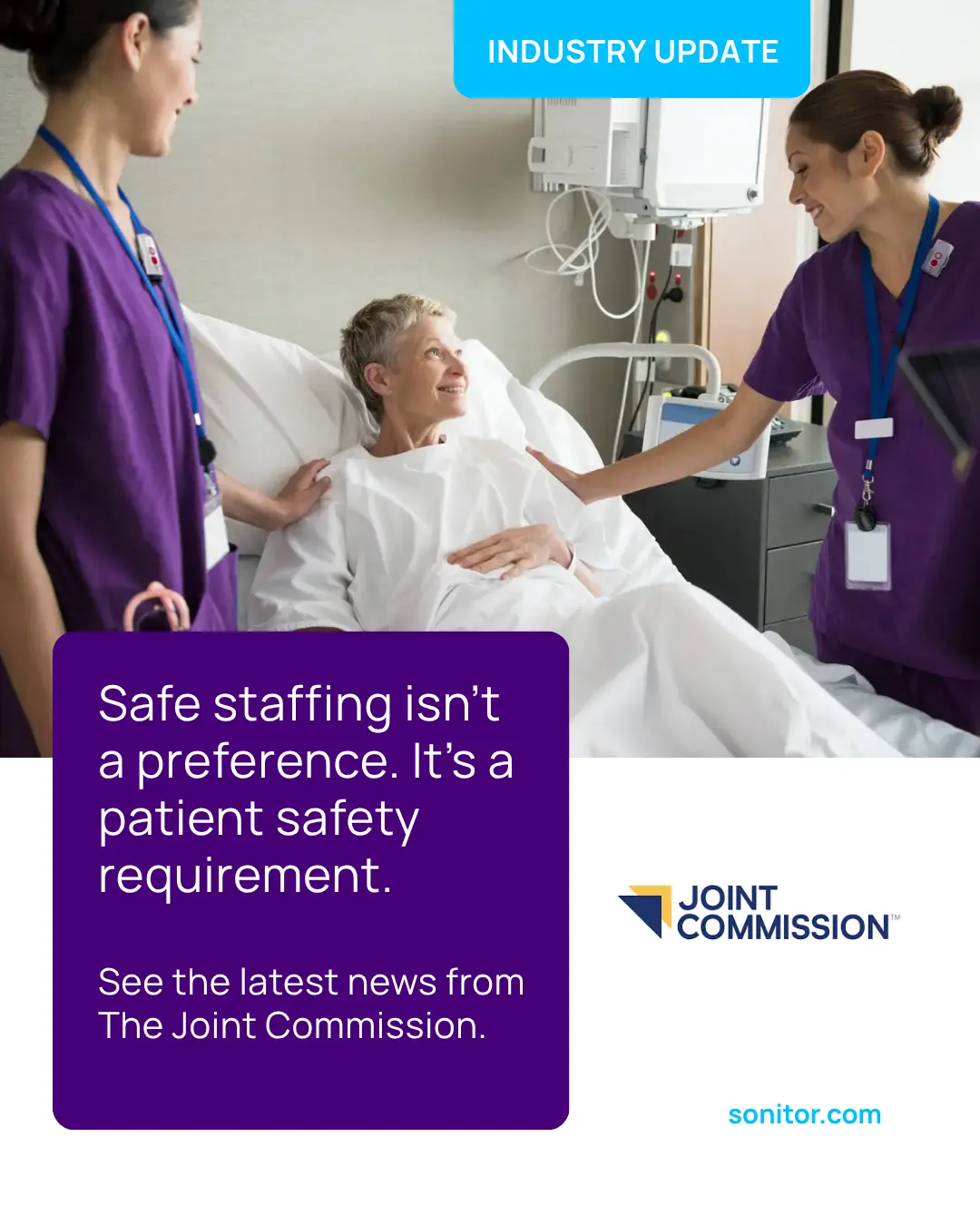
Safe staffing isn’t a preference. It’s a patient safety requirement.

Hospitals are now expected to demonstrate safe staffing levels with documented, objective evidence. Not policies on paper. Not good intentions. Real data.

This is a defining moment for our profession.

For the first time, regulatory expectations are catching up to what nurses at the bedside have always understood. You cannot deliver safe care without the right people, in the right place, at the right time.

But here’s the challenge we’re not talking about enough:

How do you prove it?

Most organizations still rely on self-reported staffing logs, manual rounding, or EHR timestamps that don’t reflect where care is actually being delivered. That’s not evidence. That’s a best guess.

This is the gap I’ve focused on solving in this chapter of my career.

At Sonitor, we use ultrasound-based RTLS to provide continuous, real-time visibility into where care is actually happening.

No missed scans. No manual logs. No guesswork.

When The Joint Commission walks in, our clients don’t scramble.

They open a dashboard and show exactly what happened.

The standard has changed. The question now is whether your infrastructure can meet it.

We owe it to our patients, and to every nurse who has ever been stretched beyond what’s safe…to get this right.

How is your organization preparing to meet the new staffing expectations?

About the Author

Teresa Brasac

PhD, MSN, MBA, APRN

Teresa is Chief Clinical and Informatics Officer at Sonitor Technologies and is responsible for leading Sonitor’s strategy for clinical evidence-based design, data analytics, clinical applications and implementation of enterprise level clinical solutions that leverage real-time location systems. She works closely with Sonitor’s implementation teams and R&D leadership to expand the data sets we capture to enhance the care delivered at the bedside. She has led successful technology implementation programs in large hospital systems and IDNs incorporating various connected medical device projects and house wide RTLS deployments. Teresa received her PhD degree in Nursing from Barry University. The focus of her dissertation and professional passion is learning and implementing medical device technology at the bedside. She received her undergraduate degree, Master’s degree in business administration, and Master’s degree in Nursing from Florida International University where she also received her Advance Practice Registered Nurse (APRN) degree. Her nursing background is in Oncology and Hospice. She developed the evidence-based IT implementation design model that she uses to lead smart room technology implementations. In the past 10 years, Teresa has worked with the larger U.S. health systems designing and implementing technology that leverages maximum utilization, integration and measurable outcomes using an evidence-based IT implementation methodology design.

Subscribe to Sonitor Insights

Join our mailing list to receive the latest on Sonitor’s innovations in real-time location systems, product launches like SonitorONE™, industry news, use-case stories and more, delivered straight to your inbox.